
What Is Strabismus in Children? A Clear Explanation

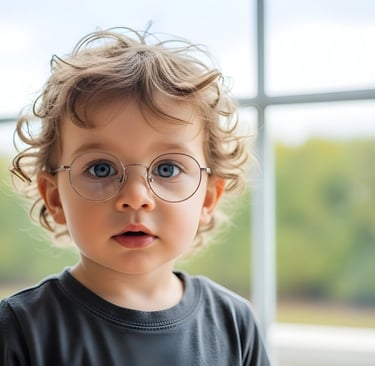
Parents often notice it first in photos.
One eye seems to turn inward… or drift outward… especially when a child is tired or focusing on something close. This condition is called strabismus — commonly known as eye misalignment. It means the two eyes are not pointing in the same direction at the same time.
Understanding what this means — and what it does not mean — can make the situation much less frightening.
What exactly is happening?
For clear, single vision, both eyes must work together. Each eye sends an image to the brain, and the brain combines those two images into one. In strabismus, the eyes are not aligned properly. One eye may look straight ahead, while the other turns:
inward (esotropia)
outward (exotropia)
less commonly upward or downward
When alignment is inconsistent, the brain receives two different images. In young children, the brain may respond by suppressing (ignoring) the image from the misaligned eye to avoid double vision. Over time, this suppression can affect visual development.
Does strabismus always mean poor vision?
Not necessarily — but it can.
If one eye is consistently misaligned, the brain may rely more on the stronger eye. This can lead to amblyopia (sometimes called “lazy eye”), where vision does not develop normally in the weaker eye. The earlier strabismus is detected and treated, the better the chances of preserving normal visual development.
Is it always obvious?
No.
Strabismus may be:
constant
intermittent
more noticeable when a child is tired
more visible when focusing at near
In some children, what looks like crossing may actually be pseudoesotropia — an optical illusion caused by facial features such as a broad nasal bridge or epicanthal folds. In those cases, the eyes are aligned normally. A proper examination distinguishes between the two.
What causes strabismus?
There isn’t always a single cause. It may be related to:
imbalance in the eye muscles
significant refractive error (especially farsightedness)
neurological or developmental factors
family history
In accommodative esotropia, for example, uncorrected farsightedness causes a child to over-focus. That focusing effort is linked to inward turning of the eyes. In these cases, glasses alone may correct the alignment.
How is it evaluated?
A pediatric eye examination typically includes:
assessment of eye alignment
measurement of refractive error
evaluation of eye movements
testing for amblyopia
examination of overall eye health
This is structured and systematic — not guesswork. In many cases, early diagnosis allows for straightforward treatment.
What are the treatment options?
Treatment depends on the type and cause of strabismus. Options may include:
Glasses (especially in accommodative esotropia)
Patching therapy to treat amblyopia
Eye muscle surgery to improve alignment
Occasionally, botulinum toxin injections
The goal is not only cosmetic alignment — it is to support healthy visual development and binocular vision whenever possible.
Will my child outgrow it?
True strabismus does not simply disappear on its own. Some intermittent forms may appear less noticeable at times, but persistent misalignment requires evaluation. The important message is this:
Strabismus is common.
It is treatable.
And outcomes are generally very good when addressed early.
When should you seek evaluation?
If you notice:
a constant eye turn
frequent drifting
squinting or closing one eye
head tilting to focus
concerns raised during pediatric screening
it is reasonable to schedule a comprehensive eye examination. Early assessment provides clarity — and often reassurance.
This is a topic that can feel alarming at first. But in most cases, with timely care and appropriate treatment, children do very well. Understanding the condition is the first step. Proper follow-up is what supports healthy visual development over time.
Bernani - Clear Eye Guidance
© 2026. All rights reserved.