
Sudden Floaters and Flashes of Light: What They Mean
Sudden floaters or brief flashes of light can feel unsettling.
Many people begin to wonder whether something serious is happening inside the eye — especially when these symptoms appear unexpectedly.
In most cases, however, floaters and flashes are related to natural, age-related changes in the vitreous, the gel-like substance that fills the eye. Understanding what causes these sensations can reduce unnecessary worry and help clarify when medical evaluation is appropriate.
What Are Floaters?
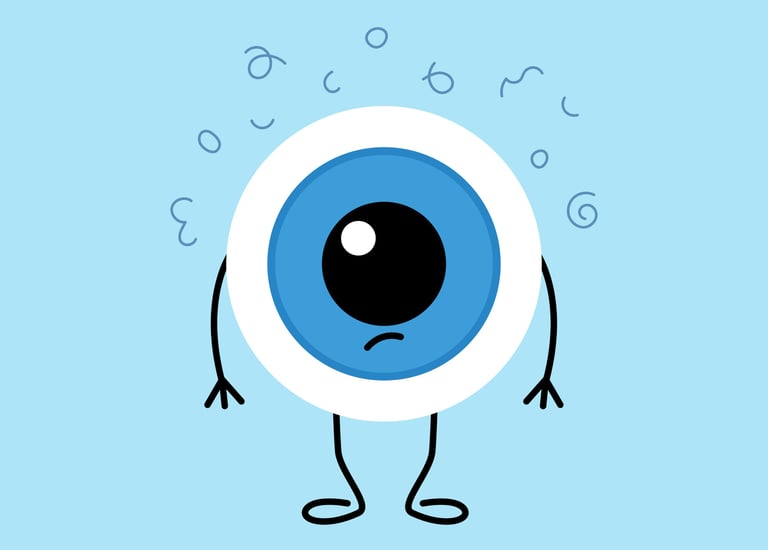
Floaters are small moving shapes in your field of vision. People often describe them as:
Cobwebs
Threads
Tiny dots
Drifting shadows
They are not on the surface of the eye. They originate inside it.
The eye is filled with a clear, gel-like structure called the vitreous body. Over time, this gel gradually becomes more liquid and may shrink slightly. As it changes, microscopic collagen fibers can cluster together and cast tiny shadows onto the retina. Those shadows are what you perceive as floaters. For most individuals, this is a normal part of aging.
What Causes Flashes of Light?
Flashes — medically known as photopsias — occur through a different mechanism. The vitreous is lightly attached to the retina, the thin, light-sensitive layer at the back of the eye that sends visual signals to the brain. As the vitreous shifts or moves with age, it can gently stimulate the retina. The retina interprets this mechanical stimulation as light — even though no external light source is present.
That is why flashes may appear as:
Brief lightning-like streaks
Small sparks
Peripheral flickers, especially in dim light
These flashes are not imagined. They reflect real stimulation of the retina.
Why Do Floaters and Flashes Often Occur Together?
Both symptoms are commonly associated with posterior vitreous detachment (PVD). PVD is a very common age-related process, especially after the age of 50. During this process, the vitreous gradually separates from the retina. In the vast majority of people, this separation occurs without complications. However, during the transition phase, traction on the retina can occasionally create a small retinal tear. This is why sudden changes in symptoms deserve attention.
When Are These Symptoms Usually Harmless?
Floaters and flashes are often benign when:
Floaters are few and stable
Flashes are brief and infrequent
There is no shadow or curtain in the visual field
Vision remains otherwise unchanged
Many people experience a temporary increase in symptoms that stabilizes as the vitreous settles. Over time, the brain also adapts, making floaters less noticeable.
When Should You Seek Prompt Evaluation?
An eye examination is recommended if you experience:
A sudden increase in the number of floaters
Flashes that become more frequent or intense
A dark shadow or curtain in part of your vision
Noticeable changes in visual clarity
These patterns require timely assessment to rule out retinal injury.
A Balanced Perspective
Most floaters and flashes are part of the natural aging process of the vitreous.
They are common.
They are often harmless.
What matters most is recognizing sudden change.
There is no need for panic — only informed awareness.
If you ever feel uncertain, a comprehensive eye examination can provide clarity and reassurance.
Bernani - Clear Eye Guidance
© 2026. All rights reserved.